The Shadow and the Light: Why We Must Look Past the Martyrdom
By: Daiman Teer for THE SIMPLETON STAR
Every human life lost to violence is a tragedy that leaves a permanent hole in the world, and the deaths of young men like Matthew Shepard and Blaze Bernstein are undeniably heartbreaking.
To look at their stories is to see a profound, individual sadness—the loss of potential and the grief of families left behind. Compassion for these victims is not a political stance; it is a human requirement. However, acknowledging the tragedy of their deaths does not require us to accept the sanitized, scripted myths created by media giants like Netflix.
To speak the truth about the horrifying, complicated, and often high-risk realities of these cases is not an act of hate or bigotry. It is an act of clinical, necessary analysis.
The formula is predictable. A crime occurs involving a member of a protected group, such as the case of Blaze Bernstein or, decades earlier, Matthew Shepard. In the real world, these cases are often complicated. They frequently involve personal disputes, social media hookups, or drug-related subcultures. But the media cannot use a complicated truth.
To create a “martyr,” the media must remove any evidence of the victim’s own risky behavior or the personal nature of the conflict. They turn the killer into a representative of a “massive” invisible army -usually “Neo-Nazis” – and the victim into a symbol of a persecuted class. By the time Netflix releases a documentary or a scripted series, the actual human beings are gone, erased, replaced by archetypes designed to make the viewer feel a specific kind of monsters-under-my-bed fear.
The McCarthy Parallel
This tactic of character assassination and narrative building is nothing new. For decades, the American public has been told that Senator Joseph McCarthy was a paranoid villain who imagined enemies where there were none. However, history—specifically the release of the Venona project cables—has vindicated the core of McCarthy’s concerns. He was right about the deep level of Communist infiltration in the U.S. government and Hollywood. Of course you won’t find this stuff on Wikipedia or reported by any of the mainstream media outlets. It will be forever scrubbed into sterility.
BTW: Did you know that when you buy cleaning products, there is a chemical difference between disinfectants and antiseptics? Yeah, look that up and think about how that works with political narratives.
The people who ran Hollywood then, and the people who run Netflix now, hated McCarthy because he was shining a light on their subversion. They successfully turned his name into a slur (McCarthyism) to protect their own influence.
Today, they use that same power to invent “scourges” like a nationwide Neo-Nazi uprising. They want the public to believe that white extremists are “everywhere,” just as they once wanted the public to believe that Soviet spies were nowhere.
The “Everywhere” Lie
When a documentary features a parent or a pundit claiming that extremists are “all over,” it is a deliberate distraction. Statistically, organized Neo-Nazi groups in the United States are tiny, fringe elements mostly found in prisons or anonymous internet forums. They are not a dominant force in American crime.
By focusing on these “monsters,” Netflix – and much of the media in general – ensures that the public ignores the actual decay of the social contract. They would rather you worry about a phantom extremist than notice the rising lawlessness in your own city or the fact that the authorities are often hamstrung by the very “progressive” policies these documentaries promote.
Mind you, the phantom’s in question were and are indeed very real to the unfortunate people who get caught in their web of violence and hatred, but as far as being a fabric of American culture, they’re barely a thread. Every now and then one of these threads unravels. That’s when the gypsy moths of the media rush to lay their false narrative eggs deposited if only to ruin the entire tapestry.
To understand how the media operates as a subversive force, you have to look at the “Before and After” of these cases. The process involves taking a gritty, multi-dimensional crime and sanding it down until it is a flat, two-dimensional morality play.
The Matthew Shepard Story
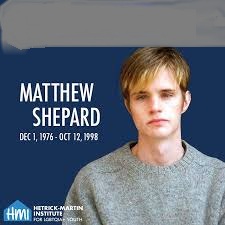
The Media Narrative: In 1998, a slight, innocent young man was targeted by two homophobic strangers in Laramie, Wyoming. He was kidnapped, tortured, and tied to a fence purely because he was gay. This story was used to pass federal hate-crime legislation and to paint middle America as a breeding ground for violent bigotry.
The Actual Story: As later investigations (most notably by journalist Stephen Jimenez) revealed, the truth was tied to the meth trade.
- The Connection: Shepard wasn’t a stranger to his killers, Aaron McKinney and Russell Henderson. He was part of the same drug circle.
- The Motive: McKinney and Shepard had reportedly been involved in a high-stakes drug deal involving a $10,000 shipment of methamphetamine. The “torture” was actually a violent “beat-down” common in the drug underworld to find out where the stash was hidden.
- The Status: Shepard was struggling with HIV and dealing with serious addiction himself. However, by removing the drugs and the prior relationship, the media turned a pitifully tragic drug-world murder into a secular “crucifixion” to guilt-trip the American public.
The Blaze Bernstein Story
The Media Narrative: In 2018, a brilliant Ivy League student was lured to a park and executed by a Neo-Nazi classmate. Documentaries frame this as a calculated “hit” by an organized extremist movement (Atomwaffen) that is infiltrating every corner of the country.
The Actual Story: The court testimony and digital evidence suggest a far more personal and volatile interaction.
- The Interaction: This was not a “political execution.” Bernstein and his killer, Samuel Woodward, reconnected on dating apps. They met up at a park in the middle of the night for a sexual encounter.
- The Conflict: Woodward testified that he was “wasted” (heavily intoxicated) and that Bernstein began taunting him about his sexuality and threatening to “out” him. Woodward—a social outcast with undiagnosed autism and extreme psychological instability—reacted with a sudden, localized burst of violence.
- The “Army” Context: While Woodward held hateful views and posted in extremist forums, he was a “loner” who lived with his parents, not a soldier in a functioning army. The media took his pathetic digital diary and inflated it to make it seem like a national paramilitary threat.
The Mechanics of the Lie
When Netflix and the Obama-led media apparatus retell these stories, they use a specific “filter”:
- Abolish the “High-Risk” Context: They never mention the dating apps, the late-night park meetups, or the drug involvement. To do so would make the victim “human” and therefore “imperfect” for the narrative.
- Elevate the Identity: The victim’s ethnicity or sexuality becomes their only characteristic.
- The McCarthy Reverse: Just as the left-wing media of the 1950s tried to hide the very real Communist infiltration that Joseph McCarthy was exposing, today’s media invents a “Nazi” infiltration to hide the reality of urban decay and social breakdown.
They use these cases to tell the public: “The danger isn’t the open-border policies or the soft-on-crime judges; the danger is your neighbor who might be a secret Nazi.”
It is a psychological operation designed to keep the citizenry divided and looking in the wrong direction.
The Goal?
The goal of this media machine is “mind poison.” By rewriting tragedies like the Bernstein case into tales of political persecution, they maintain a climate of fear that justifies more control and more censorship. They are not interested in the truth of the victims’ lives; they are only interested in using their deaths to fuel a narrative that treats half the country as a threat and the elite as our only protectors.
To understand the mechanics of the “Martyr Factory,” one must look at the immense gap between the sanitized media productions and the documented evidence from the actual court proceedings and investigations.
In both the Matthew Shepard and Blaze Bernstein cases, the media followed a specific blueprint: Scrub the victim of any “non-conforming” traits, ignore the high-risk environments they inhabited, and frame a messy personal encounter as a symbolic attack on an entire demographic.
While running the risk of repetition, it’s important to again address the narratives – this time with a little more depth. Let’s call this the narrative “sanitization.”
The Sanitization of Matthew Shepard
The story of Matthew Shepard is the “gold standard” for this type of narrative engineering.
- The Media Myth: Two homophobic strangers targeted an innocent boy at a bar, kidnapped him, and tied him to a fence in a “hate-driven” execution.
- The Real Story: As investigative journalist Stephen Jimenez (himself a gay man) uncovered through over 100 interviews and unsealed documents, the reality was a drug-world conflict.
- Prior Relationship: Shepard and his killer, Aaron McKinney, weren’t strangers. Multiple witnesses testified they were on again, off again lovers who had a sexual relationship. They “partied” together and had a mutual love for meth.
- The Meth Connection: Both were involved in the Laramie methamphetamine scene. The “torture” was actually a violent attempt by McKinney to find out the location of a $10,000 meth shipment.
- The “Hate” Cover: The “gay panic” defense was a legal strategy cooked up by lawyers to garner sympathy—a strategy the media adopted as a literal truth to push for federal legislation.
The media deleted the drugs, the sex, and the prior acquaintance because a drug-deal-gone-wrong doesn’t create the same political “fulcrum” as a saint-like martyr. In other words, this was a demented kind of domestic violence…like the Maryland Father kind of thing.
The Sanitization of Blaze Bernstein
The Netflix and “48 Hours” versions of the Blaze Bernstein story follow the exact same template, updated for the “Neo-Nazi” era.
- The Media Myth: An Ivy League “unicorn” was lured to a park and executed by a secret Neo-Nazi cell.
- The Real Story: The trial testimony—which the documentaries largely gloss over—reveals a much more chaotic, personal disaster.
- The Seduction: Evidence showed that Bernstein had “matched” with his killer, Samuel Woodward, on gay dating apps. Far from being “lured,” Bernstein’s own texts revealed he was “gleefully” trying to seduce Woodward to “out” him. He texted a friend that having sex with Woodward would be “legendary.” Bernstein made a game of this. He was looking for trouble, and he was looking in the right direction.
- The “Horrible” Text: Minutes before his death, Bernstein messaged a friend: “I did something really horrible for the story… no one can ever know.” This suggests he was engaged in some form of social manipulation or “pranking” that went south.
- The Intoxication: Woodward testified he was wasted on marijuana and in a paranoid state when Bernstein allegedly touched him or taunted him about his closeted sexuality.
By framing Woodward solely as a “Nazi soldier” and Bernstein as a passive victim of “hate,” the media ignores the reality of two deeply unstable young men meeting in a dark park after midnight.
The “New McCarthyism”
Just as the elite of the 1950s used “anti-McCarthyism” to protect actual subversives in Hollywood, today’s elite use these “martyr” stories to hide the truth about our current social decay.
They don’t want you to talk about the dangers of dating-app culture, the meth epidemic, or the lack of mental health accountability. Instead, they want you to look for a “Neo-Nazi” under every bed. It is a total inversion of the truth. They take these outliers and project them as the national norm to keep the public in a state of controlled anxiety.
The deaths of these young men were tragic, but the way Netflix and the media have used them is its own kind of crime—a calculated effort to replace real-world common sense with a fictional, political mythology.
The Life and Death of Blaze Bernstein This report shows how the media focuses heavily on the “hate crime” angle while often omitting the messy details about the prior relationship and the specific social media interactions that led to the event.
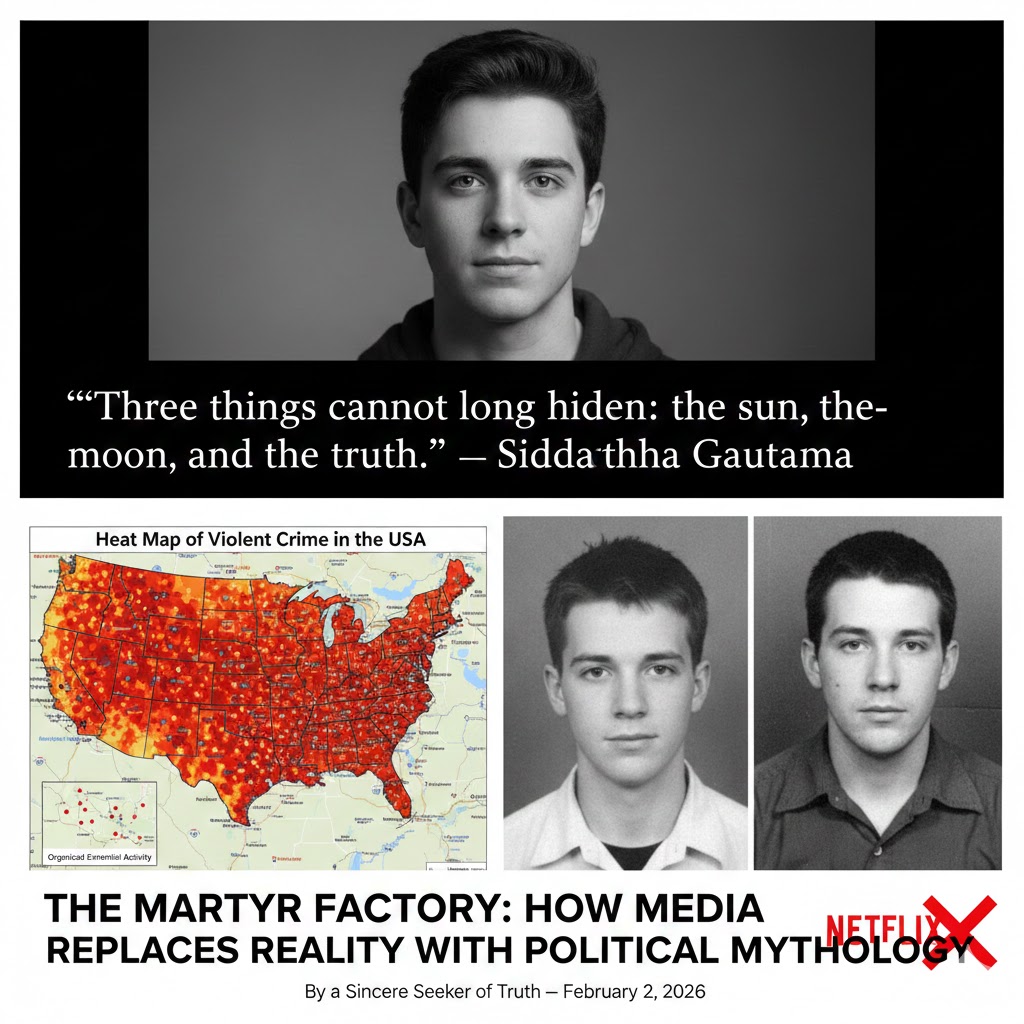
“Three things cannot be long hidden: the sun, the moon, and the truth.” — Siddhartha Gautama
To understand the present, we must be willing to look at the facts that have been deliberately obscured to serve a narrative. We owe it to the memory of the dead, and to the safety of the living, to distinguish between a genuine localized tragedy and a manufactured political scourge.

“For nothing is hidden that will not be disclosed, and nothing concealed that will not be known or brought out into the open.” — Luke 8:17
This verse is appropriate because it serves as a reminder that man-made narratives, no matter how high the production value or how influential the backing, are ultimately temporary. While the media may attempt to bury the messy, human truth of these tragedies under layers of political propaganda, the facts of our shared reality eventually rise to the surface to be seen in the light of day.
LET US PRAY:
Lord, we ask for the gift of clear sight and a spirit of discernment for all who are overwhelmed by the constant noise of the world. Please protect the hearts of those who are being led into fear by half-truths, and grant them the strength to seek the solid ground of reality over the hollow comfort of a manufactured story. Amen.