BY: DAIMAN TEER for THE SIMPLETON STAR
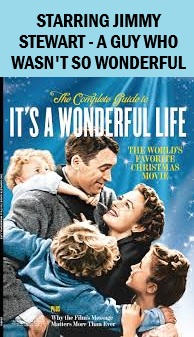
In 1946, Jimmy Stewart was forty pounds underweight, suffering from what we now recognize as PTSD, and convinced his career was over. He wasn’t the “aw-shucks” George Bailey; he was a desperate actor clinging to a contract. Frank Capra, similarly desperate, cast Donna Reed—a girl from Iowa who actually possessed the genuine Midwestern sincerity Stewart only faked. Reed was twenty-five, radiant, and the literal heartbeat of It’s a Wonderful Life. Without her, the movie is just a story about a man yelling at his kids in a drafty house.
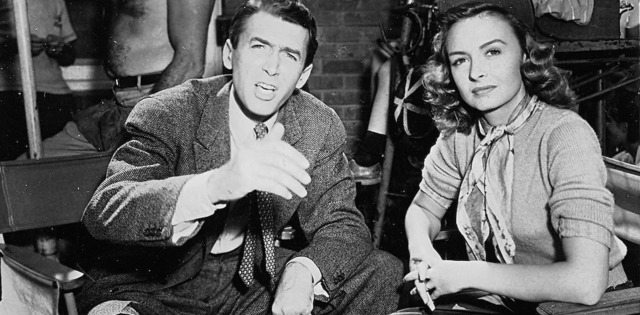
But when the film premiered, it was a box-office disaster. It lost over half a million dollars. In the brutal logic of the studio system, someone had to hang for the failure. A “real” George Bailey would have taken the hit for his team. The “real” Jimmy Stewart, however, went straight to Capra and the executives with a knife in his hand. He didn’t blame the script, the lighting, or the grim post-war mood of the country. He blamed Donna Reed.
The Scapegoat in a Party Dress
Stewart’s ego couldn’t handle the idea that he was no longer “box-office gold.” He began a whisper campaign that Reed “wasn’t a big enough star” to carry his weight. He told anyone who would listen that her “lack of experience” was the reason the film tanked. This wasn’t just a private grumble; it was a professional execution. By pinning the failure on a young actress, Stewart protected his own lead-man status. He essentially told the industry, “I’m still a star; she’s just a weight around my neck.”
He never spoke to her again. He never sent a note of thanks for the performance that made his career immortal. Instead, he effectively blacklisted her from his orbit. Years later, when they were both established, Stewart reportedly had her removed from a potential project because he “needed a hit” and didn’t want to be associated with the “bad luck” of her face. He treated her like a cursed object rather than a colleague.
The “Aww-Shucks” Assassin
The most galling part is how Stewart used his military record and his trademark stutter to play the martyr. He was the “Colonel” who returned to the greasepaint of Hollywood, and the public ate it up. Behind the scenes, he was a Tom Cruise-level obsessive, a man who lived and breathed “the biz” to the exclusion of all else. While he was playing the devoted family man, he was a notorious “catnip” for leading ladies, engaging in cold, tactical affairs that the studios scrubbed from the record to keep the “Main Street” image pristine.
He was a jerk-off who understood the power of a brand. He knew that as long as he kept stammering and looking at his shoes, he could step on anyone he wanted. Donna Reed spent her life being asked about “George Bailey,” and she always answered with grace, despite knowing the man behind the character had tried to bury her career to save his own. Stewart was a ruthless operator who cleared the board of anyone who didn’t serve his trajectory. He didn’t stand up to Mr. Potter; he was Mr. Potter with a better publicist and a more convincing stutter.
Stewart didn’t just hurt Donna Reed; he erased her contribution to the only thing people remember him for. He took the credit, he took the legend, and he left her with the bill for his own insecurity.
The Vertigo Betrayal: Scapegoating the Master of Suspense (HITCHCOCK)
By 1958, Stewart was fifty years old and increasingly panicked about his aging face. He was no longer the boyish lead of Mr. Smith Goes to Washington, but his ego refused to let him transition into character roles. He demanded the lead in Vertigo, playing a romantic obsession opposite the twenty-four-year-old Kim Novak. The age gap was glaring, and the film—now considered a masterpiece—was a box-office flop upon its initial release.
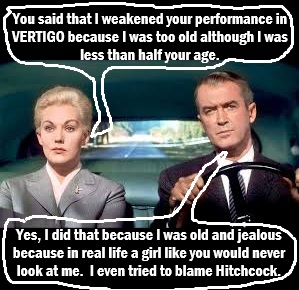
True to form, Stewart didn’t blame his own wooden, aging performance or the fact that audiences found his pursuit of a woman young enough to be his daughter unsettling. He went straight for Hitchcock’s throat. Stewart publicly and privately blamed the director for the film’s failure, claiming Hitchcock’s “obsession” with the technical aspects of the shoot had drained the “heart” out of his performance.
But the real knife in the back was Stewart’s claim that Kim Novak was “too old” for the part. At twenty-four, Novak was less than half his age, yet Stewart—the man who had perfected the “stuttering victim” routine—convinced himself that she was the reason the romance didn’t sell. He manipulated Hitchcock into believing that the casting was the problem, leading to a permanent rift between the director and the actress. Stewart used his “nice guy” credibility to poison the well, ensuring that the blame for the “flop” landed on everyone but the man in the mirror.
The Careerist in a Cardigan
Stewart’s relationship with Hitchcock was never about art; it was about the “biz.” He used Hitchcock to reinvent himself as a “darker” lead in Rear Window and Rope, but the moment a project didn’t deliver a massive ROI, Stewart turned into a cold-blooded corporate hitman. He understood that Hitchcock was a “prestige” director, and by blaming Hitchcock’s “eccentricities” for the failure of Vertigo, Stewart managed to distance himself from the disaster while keeping his own reputation as a “reliable star” intact.
He was the original Tom Cruise—obsessed with his “hit rate” to a degree that bordered on the sociopathic. He would sit in meetings with a stammer and a smile, then go behind a director’s back to ensure the marketing focused solely on him. He didn’t just step on Donna Reed; he tried to dismantle the legacy of the greatest director in Hollywood history because his own vanity couldn’t handle a bad opening weekend.
Stewart wasn’t a man of the people. He was a man of the call sheet. He spent decades pretending to be the victim of “the system” or “bad luck,” when in reality, he was the one pulling the strings, casting the blame, and making sure that no matter who got hurt or whose career got derailed, the “Jimmy Stewart” brand remained unsullied. He was a jerk-off in a cardigan who traded his humanity for a permanent spot on the A-list, and he used his “aw-shucks” routine as the ultimate silencer for anyone who tried to tell the truth.
BIBLE VERSE
“Beware of false prophets, which come to you in sheep’s clothing, but inwardly they are ravening wolves.” Matthew 7:15
WHY I CHOSE THIS VERSE:
This verse is the ultimate warning against the “aw-shucks” mask. It describes the calculated predator who uses a gentle, stuttering exterior—the sheep’s clothing—to hide a “ravening” ambition. Jimmy Stewart didn’t just play a character; he perfected a camouflage that allowed him to devour the careers of those around him, like Donna Reed, while the world cheered for his supposed humility. It reminds us that the most dangerous ego isn’t the one that roars, but the one that whispers and stammers while it sharpens the knife.
LET US PRAY:
Heavenly Father, we ask for the discernment to see through the “sheep’s clothing” of the career-obsessed narcissists who trade in false sincerity. Protect us from the “ravening wolves” in our own lives—the office martyrs and the humble-bragging ladder-climbers who would step over us in the gutter just to gain an inch of territory. Shield our hearts from their manipulation, and grant us the strength to remain upright when the sharks of the “biz” try to pull us under. Surround us with truth, and deliver us from those who sacrifice others at the altar of their own fame. In Jesus’ name we pray, Amen.