BY: Daiman Teer for The Simpleton Star
NOTE: Had it not been for the Variety trainwreck interview, I would never have known this guy’s name. In fact, no one knows his name. Still, he thinks he’s an artiste. He’s not even “just an actor.” He’s a nobody who got a part that requires no talent whatsoever. If a role requires no talent, he is your guy.
The latest issue of Variety—a publication that has devolved into a glossy catalog for the professionally vapid—features a truly nauseating display of intellectual bankruptcy. Giancarlo Esposito, a man whose entire cultural footprint consists of one decent performance he’s been overacting in ever since, has decided he is now the ideological architect of a “revolution.”
Watch this and puke. Esposito had to file for bankruptcy, and he considered suicide by arranging his own death by murder because he couldn’t afford his own children. If you believe an idiot like this would actually try this as an act of selflessness, you will believe anything.
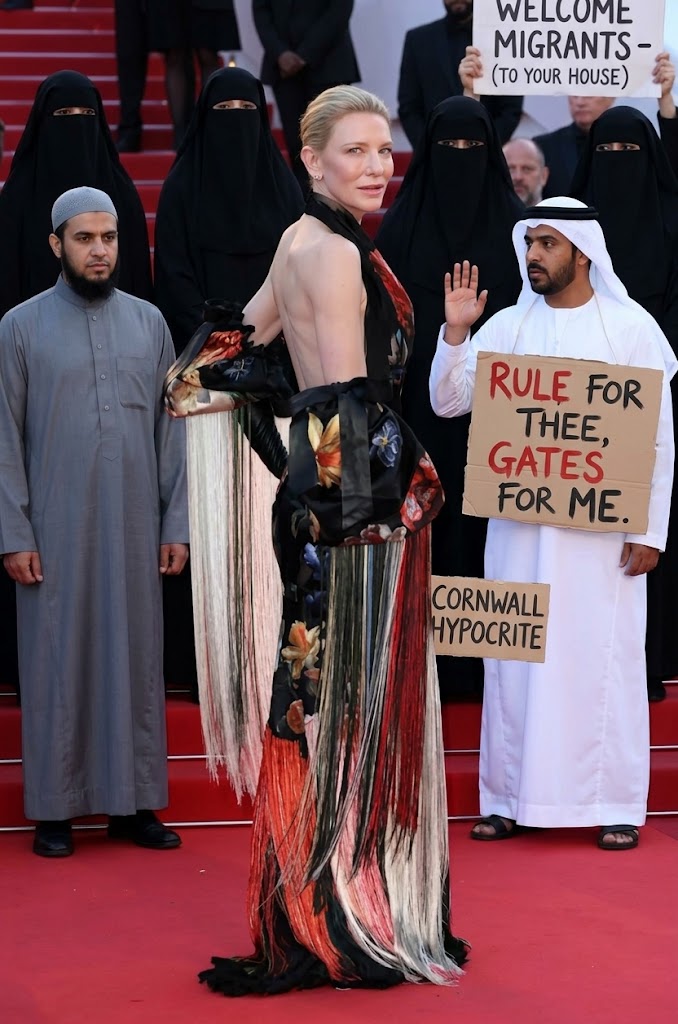
It is a special kind of comedy to watch a man of his limited range wrap himself in the affectations of a grand maestro. He showed up to the interview “dolled up” in a costume that can only be described as a desperate attempt to look like a delicate, refined intellectual—a pose that was immediately shattered the moment he opened his mouth.
Then there are the glasses. Those round, “designer” frames that scream, “Look at me, I am an artiste.” It is the ultimate tell of a gavone (He is half Italian and Italians will agree) who finally got a little bit of money and thinks a specific brand of eyewear confers wisdom. He’s the type who can’t get past the “Nordstrom look”—or worse, the type who shops at a place three levels shittier than Nordstrom that specializes in making cheap garbage look like it belongs in a conservatory. It’s a retail-store version of class that only a person with zero actual taste would find sophisticated.

Throughout the piece, Esposito leans heavily into the “I am an auteur” delusion. It’s an embarrassing bit of theater for a man who has shown zero acting range for over a decade. He’s been playing the same stiff, dead-eyed villain on a loop, convinced that his lack of versatility is actually a “process.” The truth is far more pedestrian: he is a nobody who got lucky once.
Even the most obsessed Breaking Bad fans—the people who supposedly “made” him—couldn’t tell you his name if their lives depended on it. To the world, he isn’t a talent or a thinker; he’s just “that bad guy from that one show.” He is a background player who has spent his twilight years trying to convince us he’s Orson Welles, when he’s really just a character actor whose “auteur” status exists only in his own head and the fawning pages of feckless trade rags.

The grammar of his interview was, in a word, moronic. It is difficult to take a call for “revolution” seriously when the person issuing the manifesto hasn’t quite mastered the basic structure of the English language. He speaks in the wandering, incoherent circles of someone who thinks that wearing a scarf and a pained expression is a valid substitute for a brain.
The “revolution” Esposito is calling for is nothing more than a classless, empty performance. He is a nobody clinging to the fading embers of a career, attempting to stay relevant by regurgitating revolutionary buzzwords to a magazine that wouldn’t know a real idea if it hit them on the red carpet.
The tragedy isn’t that he’s stupid; it’s that he’s so profoundly unoriginal. This isn’t a maestro leading an orchestra; it’s a nothing in a maestro’s coat, screaming into the wind because he knows deep down that the work has dried up and the only thing left to do is play-act as a radical for the cameras. He is a hollow man in an expensive outfit, and the Simpleton Star is happy to point out that the “revolutionary” is wearing nothing but affectation.
The Scriptural Context
The Verse:
“For though they knew God, they did not glorify him as God nor gave thanks to him, but their thinking became futile and their foolish hearts were darkened. Although they claimed to be wise, they became fools.” — Romans 1:21-22
The Reason I chose this verse
This verse is the definitive diagnosis of the “Maestro” complex. It addresses the exact moment where vanity overtakes reality—where a person becomes so enamored with the image of their own intellect that they lose the ability to speak sense. It reminds us that affectation is not just a social annoying habit; it is a spiritual darkening. When you pretend to be something you aren’t, your “thinking becomes futile.” You end up in a costume, speaking moronic grammar, calling for revolutions you don’t understand, while the rest of the world looks on at the sheer foolishness of the claim.
A Prayer for Those Exhausted by the Vapid
Lord, grant us the patience to navigate a world that has traded substance for a scarf and a pair of designer frames. Give us the strength to endure the loud-mouthed nobody who mistakes his luck for genius and his wardrobe for wisdom.
We ask for clarity of mind in an age where grammar is ignored and “revolution” is just another word for “I need a job.” Protect us from the “gavones” who think a Nordstrom look buys them a seat at the table of the wise.
Keep our hearts grounded in what is real, our eyes sharp to see through the affectation, and our spirits calm when the foolish are given the loudest podiums. May we find peace in the truth, far away from the feckless trade rags and the maestros of nothing.
Amen.